Wednesday, December 11, 2013

Dihybrid Cross
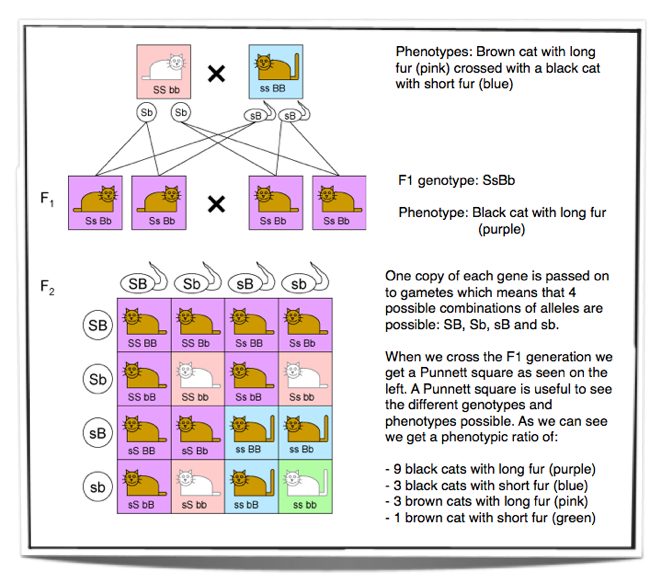
Definition: A dihybrid cross is a breeding experiment between P generation (parental generation) organisms that differ in two traits.
If a true-breeding plant with green pod color (GG) and yellow seed color (YY) is cross-pollinated with a true-breeding plant with yellow pod color (gg) and green seeds (yy), the resulting offspring will all be heterozygous for green pod color and yellow seeds (GgYy).

Examples:
In this dihybrid cross, a plant with the dominant traits of green pod color and yellow seed color is cross-pollinated with a plant with the recessive traits of yellow pod color and green seed color. If a true-breeding plant with green pod color (GG) and yellow seed color (YY) is cross-pollinated with a true-breeding plant with yellow pod color (gg) and green seeds (yy), the resulting offspring will all be heterozygous for green pod color and yellow seeds (GgYy).
Thursday, December 5, 2013
Sunday, December 1, 2013
Mendel

Introduction
Gregor Mendel
(1822-1884) was an Austrian monk who discovered the basic rules of inheritance.
From 1858 to 1866, he bred garden peas in his monastery garden and analyzed the
offspring of these matings. The garden pea was good choice of experimental
organism because:
- many varieties were available that bred true for clear-cut, qualitative traits like
- seed texture (round vs wrinkled)
- seed color (green vs yellow)
- flower color (white vs purple)
- tall vs dwarf growth habit
- and three others that also varied in a qualitative — rather than quantitative — way.
- peas are normally self-pollinated because the stamens and carpels are enclosed within the petals. By removing the stamens from unripe flowers, Mendel could brush pollen from another variety on the carpels when they ripened.
The first cross
Mendel crossed a
pure-breeding round-seeded variety with a pure-breeding wrinkled-seeded one.
Our interpretation
The
parents (designated the P generation) were pure-breeding because each was homozygous for the alleles at the gene locus (on chromosome
7) controlling seed texture (RR for round; rr for wrinkled).
The results
All
the peas produced in the second or hybrid generation were round.
Operon System
In genetics, an operon is a functioning unit of genomic DNA
containing a cluster of genes
under the control of a single regulatory signal or promoter.[1][2] The genes are transcribed
together into an mRNA strand
and either translated
together in the cytoplasm, or undergo trans-splicing to create
monocistronic mRNAs
that are translated separately, i.e. several strands of mRNA that each encode a
single gene product. The result of this is that the genes contained in the
operon are either expressed
together or not at all. Several genes must be both co-transcribed and co-regulated
to define an operon.[3]
Originally, operons
were thought to exist solely in prokaryotes, but since the
discovery of the first operons in eukaryotes in the early
1990s,[4][5] more evidence has arisen to suggest they are more common
than previously assumed.[6] In general, expression of prokaryotic operons leads to
the generation of polycistronic mRNAs, while eukaryotic operons lead to
monocistronic mRNAs.

Protein Synthesis
Proteins
are assembled from amino acids using information encoded in genes. Each protein has its own
unique amino acid sequence that is specified by the nucleotide sequence of the
gene encoding this protein. The genetic code is a set of
three-nucleotide sets called codons
and each three-nucleotide combination designates an amino acid, for example AUG
(adenine-uracil-guanine) is the code for methionine. Because DNA contains four nucleotides, the
total number of possible codons is 64; hence, there is some redundancy in the
genetic code, with some amino acids specified by more than one codon.[6] Genes encoded in DNA are first transcribed
into pre-messenger RNA
(mRNA) by proteins such as RNA
polymerase. Most organisms then process the pre-mRNA (also known as a primary transcript) using various forms of Post-transcriptional
modification to form the mature mRNA, which is then used as a template for
protein synthesis by the ribosome.
In prokaryotes the mRNA
may either be used as soon as it is produced, or be bound by a ribosome after
having moved away from the nucleoid.
In contrast, eukaryotes
make mRNA in the cell
nucleus and then translocate it
across the nuclear
membrane into the cytoplasm,
where protein
synthesis then takes place. The rate of protein synthesis is higher in
prokaryotes than eukaryotes and can reach up to 20 amino acids per second.[7]
The
process of synthesizing a protein from an mRNA template is known as translation. The
mRNA is loaded onto the ribosome and is read three nucleotides at a time by
matching each codon to its base
pairing anticodon
located on a transfer RNA
molecule, which carries the amino acid corresponding to the codon it
recognizes. The enzyme aminoacyl tRNA
synthetase "charges" the tRNA molecules with the correct amino
acids. The growing polypeptide is often termed the nascent chain. Proteins are always biosynthesized from N-terminus to C-terminus.[6]
The size
of a synthesized protein can be measured by the number of amino acids it
contains and by its total molecular
mass, which is normally reported in units of daltons
(synonymous with atomic
mass units), or the derivative unit kilodalton (kDa). Yeast proteins are on average 466
amino acids long and 53 kDa in mass.[5] The largest known proteins are the titins, a component of the muscle sarcomere, with a molecular
mass of almost 3,000 kDa and a total length of almost 27,000 amino acids.[8]

DNA Replication
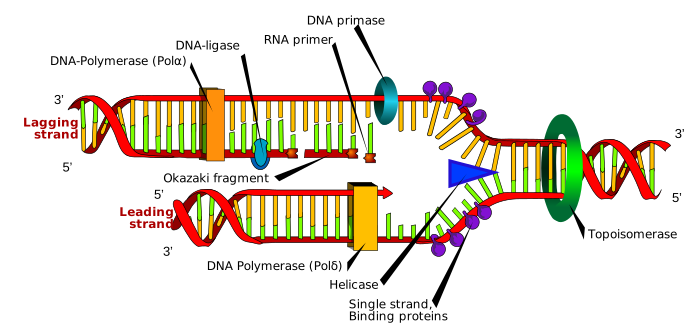
DNA replication is the process of producing two
identical copies from one original DNA
molecule. This biological process occurs in all living organisms and is
the basis for biological
inheritance. DNA is composed of two strands and each strand of the original
DNA molecule serves as template for the production of the complementary strand,
a process referred to as semiconservative
replication. Cellular proofreading and
error-checking mechanisms ensure near perfect fidelity for DNA replication.[1][2]
In a cell, DNA replication
begins at specific locations, or origins of
replication, in the genome.[3] Unwinding of DNA at the origin and
synthesis of new strands results in replication forks
growing bidirectionally from the origin. A number of proteins are associated with
the replication fork which assist in the initiation and continuation of DNA
synthesis. Most prominently, DNA polymerase
synthesizes the new DNA by adding complementary nucleotides to the template
strand.
DNA
replication can also be performed in
vitro (artificially, outside a cell). DNA polymerases isolated from
cells and artificial DNA primers can be used to initiate DNA synthesis at known
sequences in a template DNA molecule. The polymerase chain
reaction (PCR), a common laboratory technique, cyclically applies such
artificial synthesis to amplify a specific target DNA fragment from a pool of
DNA.
http://upload.wikimedia.org/wikipedia/commons/8/8/DNA_replication_en.svg
Subscribe to:
Posts (Atom)